
How to help yourself
Lessons from the life of Archibald CXVIII
A few months ago I picked up Greg McKeown’s bestselling book Essentialism, which appeared to be a fairly standard self-help manual of the type commonly found in airport bookstores, but nevertheless came highly recommended by several people I like and respect.
Essentialism promotes a philosophy of lifestyle minimalism, not for physical objects but for plans, projects, and commitments, stripping one’s life down to The Essentials to free up time and energy to focus on what Really Matters. McKeown tells us that we should explore many options before committing to one, saying “hell no” to anything that isn't a “hell yes”. He goes further, urging that we learn how to un-commit, extricating ourselves from plans and relationships (be they romantic, platonic, or professional) that no longer serve our needs.
The book fell into my hands—out of a box marked “FREE” on a Brooklyn stoop—at exactly the right time. For months [okay, years] I’d been saying “yes” to everything I physically could, running myself ragged on social and creative ventures which, while engaging, lacked a clear purpose. My schedule was maxed out beyond control or enjoyment, and I was looking for some practical tips on stopping this cycle of social burnout. For me, the advice and frameworks in Essentialism were both timely and relevant, and I found something worth highlighting on nearly every page.1
But it was also incredibly tedious to read. The book’s prose is as bland and digestible as baby formula, with a monotonous, repetitive structure that struck me as almost patronizing, as if McKeown was unwilling to lose even his least-attentive readers. His mawkish anecdotes, concerning the lives of C-Suite Executives, Silicon Valley Entrepreneurs, and Award-Winning Creatives, will likely fall flat for any but the most neoliberalism-pilled.
But none of this makes Essentialism particularly unique—it is, if anything, better-written than the average self-help manual.
During the months I spent sporadically outlining at this essay, I interviewed twenty or so people—friends, family, acquaintances, and a couple strangers—about their relationship with self-help books. Do you read them? If so, which ones? If not, why? Etcetera.
[I should clarify at this point what I mean by “self-help”, because one of my interviews ended in an hour-long argument about what does and doesn't qualify. By self-help, I mean a work whose primary function is to provide guidance or advice on some general aspect of life—health, money, productivity, career, relationships, you name it. In short, any book you read to help solve a personal problem.
Like all genre definitions, this one is fuzzy and porous, which is to say bad. Is Cracking the Coding Interview a self-help book? Certainly not, but it does help you solve the “personal problem” of scoring a highly paid position in the tech industry, so it does technically fit my definition.
In the end, we must resort to that time-honored backstop for adjudicating all categorical disputes: I know it when I see it.]
Roughly half the people I interviewed claimed that they’ve never read a self-help book in their lives.2 When I asked why, the most common answer was that they think they are, simply put, cringe. Funnily, the other half—the self-help readers—largely agreed. It seems to be a widely-accepted truth (among the people I know) that self-help books are, as a rule, aesthetically worthless.3
In The Writing Life, Annie Dillard wrote that before a young person can determine whether they could be a writer, they should at first ask themselves: “do you like sentences?” When reading a self-help manual, one rarely gets the sense that the author could be bothered about them. They often feel more like works of engineering than art, built like an airplane, with lots of failsafes and redundancies. The text is usually laden with clichés, platitudes, vaguely-defined concepts, and ill-conceived jargon. All too often they’re packed with pseudoscience (i.e. psychology), while making every effort to appear straightforward and guileless. Like Ron Swanson, a self-help author abhors a metaphor, preferring instead the arts of anecdote and analogy.
[I realize that for a certain kind of person, many these qualities are perfectly acceptable, even admirable. Why shouldn’t an author state their point in the plainest english possible? Why make your readers do any interpretive labor? And what’s wrong with an author repeating themself, if it helps the reader remember? I acknowledge that these features can make a text more efficient and functional (more on that in the next post), and suffice it to say I’m well aware that my aesthetic preferences are not Authoritative.]
Worst of all, upon reading your second, or third, or (heaven forbid) tenth self-help manual, you quickly find that they are all, structurally, exactly the same. Every one of the self-help books I've read (nine and counting) has followed a nearly-identical formula, which I’ll outline now for the half of you reading who aren't familiar with the genre (the other half should already know it by heart).
Each chapter in a self-help book goes something like this:
I: The Anecdote
In which the author presents a relatable story of failure, frustration, or confusion:
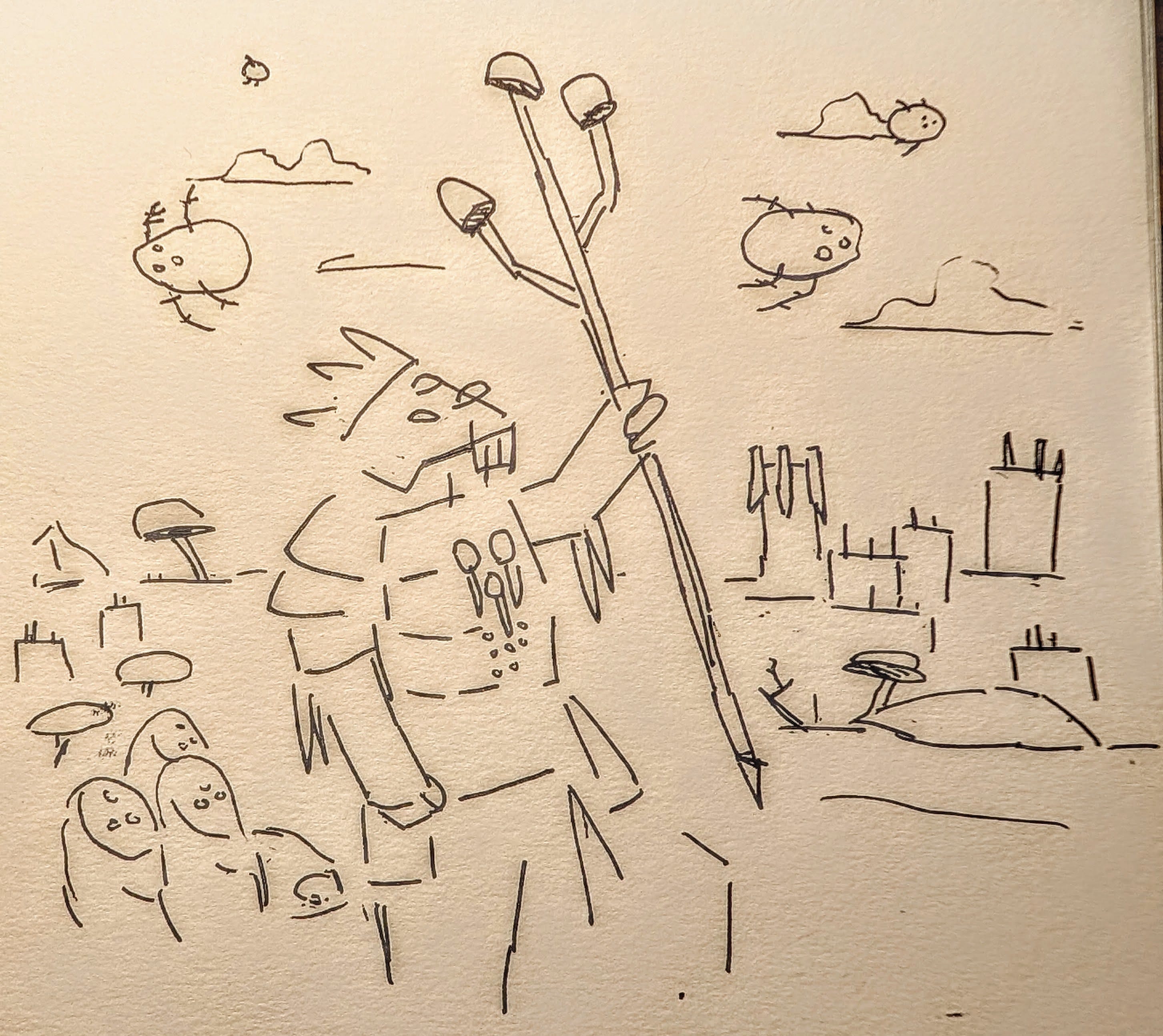
In the late 70th Century, King Archibald CXVI laid siege to the Grizz at Horispex System. After subduing his enemy, Archibald planned to strip mine their planet for it’s precious synergite, which his royal diviners had detected in abundance on their long-range scans. But this was easier said than done—each time the Archibaldian war fleet approached the planetary fortifications at Horispex 4, they were rebuffed time and again by the Grizz's sophisticated point defense network. The siege dragged on for decades, in which courtly intrigues and assassination led to succession of Archibalds CXVII and CXVIII, but still the Grizz refused to surrender.
II: The Problem
In which the author diagnoses the issue illustrated by the Anecdote:
The Archibaldians suffered from a classic case of Objective Fixation. They had narrowly defined their goal as “defeating the Grizz”. But was that the real goal? No! They only needed the synergite, not the whole star system. But by fixating on the how (the siege), they lost sight of the why (the synergite).
III: The Solution
In which the author gives the “correct” answer to the Problem and explains it’s relevance to the reader:
Whenever you get stuck on a tricky problem like this, you can try a technique called Objective Inversion. This is the simple, powerful act of asking not “how do I solve this problem”, but rather “what is the problem, really, and is there some other way I can achieve it.”
Consider your own life. Maybe you're grinding away to get that big promotion, spending night after night working late at the panopticoffice trying to impress your overseer. Weeks turn into months, performance inspections come and go, but time and again you’re passed over—just like old Archibald, as he dived once more into the jaws of the Grizz.
Think: what's the problem you're actually trying to solve? Do you really need that raise? Perhaps your true goal is to save up for a down payment on that Class-C freighter you’ve been eyeing—rather than working late, you might try taking a second job, or cutting down on your spending. Instead of buying that sporemilk latte every morning, try growing your own stimulants at home. The key is to stay flexible, and don’t get stuck on the first solution you think of.
IV: The Evidence
In which the author provides the “““factual””” basis for the Solution. This often takes the form of some threadbare psychological study, which would fall apart if you so much as breathed the words “replication crisis”:
Recent breakthroughs in cognitive xenoscience have proved that this isn't just some clever trick—it's how our brains are wired. In a recent study performed on inmates at the Galactic Center for Disciplinary Corrections (GCDC), Federation neuropsychologists found that when a subject is told in advance how to solve a problem (for example, how to loosen the restraints on their correction chair), the brain's problem-solving centers actually become less active. The cure for this is Objective Inversion.
V: The Steps
In which the author outlines an actionable guide for implementing the Solution in real life:
Start by stating the Assumed Objective. Write down the problem you think you're trying to solve. For example:
Defeat the Grizz.
Identify your Root Desire. Take a moment to think about what it is you actually want.
Precious synergite.
Brainstorm alternative paths. List at least three ways to get to your Root Desire that completely ignore the Assumed Objective.
Find another source of synergite.
Build cloaked troop transports to steal the synergite.
Open trade negotiations with the Grizz.
VI: The Resolution
In which we come full circle to see how the Problem illustrated by the Anecdote was resolved using the author’s preferred Solution:
We all know what happened next: Archibald CXVIII withdrew his armada after decades of bloody (and costly!) fighting, sending a lone diplomatic envoy armed with a state-of-the-art translator drone rather than phase scramblers or neutron torpedoes. He quickly learned what his forekings could never have guessed—that for the Grizz, synergite was merely a toxic industrial byproduct, worse than worthless. Within a month, he’d signed a treaty to haul away their “garbage” for free, saving the Grizz from a potential environmental catastrophe, and achieving his true objective without firing another missile. By the time of his death at the hooves of the Zentaur Lords, he’d become the richest king in the dynasty's millennias-long history—all thanks to a clever bit of Objective Inversion.
This is the ideal form of the Resolution—if the original Anecdote lacks a satisfactory conclusion, another will be offered in its stead.
VII: The Takeaway
In which the author reviews what we’ve “learned”, summarizing the Problem, Solution, and Steps to tie everything up in a nice bow:
« The remainder of this file was corrupted in the datastar meltdown at Gargantua Five. Please consult your local hypernet for more information and related sources. »
Every self-help book is exactly like this, with no exceptions, ever.
I’m only half joking. While the pieces might be remixed or rearranged, a brief survey of the self-help shelf at your local bookstore reveals a near-ubiquitous devotion to this formula, so slavish that you'd think it was court ordered [a baffling decree, even for an Archibald].4 The result is a section at Barnes & Noble in which the individual works feel fungible, pre-fabbed, factory-farmed, generated not from an authentic creative impulse, but only so they could be packaged and sold to the nearest sucker.
This, I suspect, is the main reason that so many people—including many avid readers—won’t touch these books: nobody likes to feel like a mark. Self-help is a booming industry, and while that’s true of many art forms, there is perhaps no other genre that feels so transparently like a sales pitch, like marketing for itself. You’re being sold a product, a dream, a list of instructions for how to Live Well.
Which raises a number of questions:
Why do so many of us (myself included) read these books anyway?
Can self-help teach us—or at least help us—to Live Well, even if it may be aesthetically (and perhaps spiritually) bankrupt?
What does it mean to Live Well, anyway?
Does your therapist know how to do it? [No.]
So far we’ve focused on the form of the self-help manual. Next week [or month, or year—I make no promises] we’ll try to answer these questions by examining its function, wading into philosophical morass of the “personal development” industrial complex.
See you then.
What’s up
No potluck this month, as I’ll be in Germany with Joe from September 17th to the 30th. I’m thinking October 11 or 18 for the next one—hmu if you wanna host, otherwise I will!
Reb’s animated film is going to be screened at the Climate Film Festival this year:
My film The Human Fossil will screen during the Climate Film Festival on Sept 20 at 12pm at Regal Essex Crossing, the “Soft Rains, Hard Truths: Narrative Shorts” block. This film festival is part of climate week!
I’ll be in Berlin doing the inline skate marathon that day, but YOU should absolutely go see it. I’ve seen her film three or four times and it is Extremely Good (and the other ones look cool too)—you can grab tickets here.
I read a lot of Really Good Fiction this summer, which turned out to be pivotal in helping me claw out of a brief but intense depression that struck like The Plague last June.5 Standouts include: Norwegian Wood (heartbreaking/horny), White Teeth (heartbreaking/lmao), All Fours (heartbreaking/lmao/horny), and Stoner (heartbreaking/heartbreaking).
[And there it is—my entire emotional range.]
Lmk if you have any books recs, fiction or otherwise (though I cannot promise I will like them).

Good dogs
Here are some good dogs we saw:




The two schools of self-help
So did the prior owners—the book was already heavily marked up in both English and Spanish when I found it.
When I pressed them further, this was often because we disagreed on which books count as self-help. [Turns out you don’t always know it when you see it—sad.] For example, these were two commonly disputed works:
The Body Keeps the Score, which is definitely self-help, and also (allegedly) full of shit.
Man's Search for Meaning, which is arguably self-help, and also (allegedly) fantastic.
Like all rules, there are exceptions. All About Love was one such frequently cited, but I haven't read it so I can neither confirm nor deny. Based on the title, I imagine I could learn a thing or two.
Non-literary self-help is less married to these conventions. Self-help videos, for example, are less formulaic, but usually even less rigorous, not bothering to provide even the flimsiest evidence for their claims other than the anecdotal experience of their creators.
Visiting Seattle also helped. And bupropion.